When buying a used vehicle, look beyond the price. Check its accident and service history, kilometres, previous ownership and overall condition. Inspect the tires, brakes and other important components, take a proper test drive and understand what inspections have been completed. Then compare its age, features, condition and expected ownership costs to decide whether it offers good overall value.
Buying used gives you plenty of choice, but no two used vehicles are exactly alike. Even two vehicles with the same year, make and model can have different kilometres, maintenance histories, previous uses and overall condition.
The key is knowing what to check and comparing each vehicle consistently.
UsedVehicleHub.ca gives Manitoba shoppers a convenient place to browse used vehicles available through the Birchwood dealership network. You can compare vehicles from more than 30 brands, including cars, SUVs, trucks, hybrids and electric vehicles.
Start by learning as much as you can about the vehicle’s past. A vehicle history report, service records and information from the seller can help you understand what the vehicle has been through before you consider buying it.
Has the vehicle been in an accident?
An accident doesn’t automatically mean you should avoid a vehicle.
What matters is the extent of the damage, how it was repaired and the vehicle’s condition today.
Review the available vehicle history information and ask about previous accidents or significant repairs. If damage appears on a history report, ask what happened and what work was completed.
When buying from a licensed Manitoba dealer, there are specific disclosure requirements. Dealers must disclose certain facts about a vehicle’s history and condition, including some types of previous damage and use.
Private sellers don’t have the same disclosure requirements, making it especially important to do your own research when buying privately.
Are service records available?
Service records can help show how consistently a vehicle has been maintained.
Look for regular oil changes and other scheduled maintenance. Depending on the vehicle’s age and kilometres, you may also want to know whether larger maintenance items have already been completed.
If records aren’t available, that doesn’t automatically mean the vehicle wasn’t maintained. It simply means you have less information, so ask the seller what maintenance has been completed and where it was serviced.
How many kilometres are on the vehicle?
Kilometres are important, but don’t use them by themselves to judge a used vehicle.
A lower-kilometre vehicle isn’t automatically a better choice than one with more kilometres. Age, maintenance history, previous use and current condition all affect value.
For example, a higher-kilometre vehicle with consistent maintenance may compare well with a lower-kilometre vehicle that has limited service information or needs significant maintenance.
Compare the kilometres with the vehicle’s age, history, condition and asking price.
What do you know about previous ownership?
Ask what is known about the vehicle’s previous ownership and use.
The number of previous owners can provide context, but don’t make your decision based on that number alone. Maintenance and current condition usually tell you more about the vehicle you’re considering.
You should also confirm that the VIN on the vehicle matches its paperwork.
2. Look Closely at the Exterior and Interior
nce you’re comfortable with the history, inspect the actual vehicle.
You don’t need to be a mechanic to identify things that deserve a closer look.
What should you check on the exterior?
Walk around the entire vehicle and look for:
- dents, scratches or significant body damage
- rust or corrosion
- differences in paint colour or finish
- damaged lights or glass
- unusual gaps between body panels
- tire damage
- uneven tire wear
Some cosmetic wear is normal on a used vehicle. The question is whether the condition seems reasonable for its age, kilometres, price and reported history.
This is especially relevant in Manitoba, where vehicles regularly face winter temperatures, snow, ice, road salt and changing road conditions.
What should you check inside?
Don’t judge the interior only by how clean it looks.
Check the seats, dashboard, carpets and cargo area for wear or damage. Then test the features you’ll actually use.
Depending on the vehicle, that could include:
- heating and air conditioning
- heated seats and steering wheel
- windows and power locks
- infotainment system
- backup camera
- power seats
- interior and exterior lights
- windshield wipers
- driver-assistance features
Normal wear is expected. You’re looking for problems that don’t match the vehicle’s age or kilometres and features that don’t operate properly.
3. Check the Tires and Brakes
Tires and brakes affect both safety and what you may need to spend after buying.
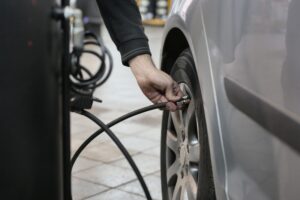
Look at the tires for remaining tread, visible damage and uneven wear. If the tires are getting close to replacement, include that expense when comparing the vehicle’s overall value.
For Manitoba drivers, also find out whether winter tires are included. If they aren’t and you plan to buy a set, include that in your budget.
During your test drive, pay attention to the brakes.
The vehicle should stop smoothly and predictably. Listen for unusual grinding or squealing and notice whether you feel vibration through the steering wheel or brake pedal.
If something doesn’t feel right, ask about it and have it investigated rather than assuming it’s minor.

4. Watch for Warning Lights, Leaks and Unusual Noises
Start the vehicle and look at the dashboard.
Some lights normally appear briefly when a vehicle starts and then turn off. If a warning light remains illuminated, ask what it means and whether the issue has been diagnosed.
Listen to the vehicle while it’s running as well. Unexpected knocking, rattling, squealing or other unusual sounds deserve attention.
You can also look underneath the parked vehicle for signs of fluid leaks.
You don’t have to diagnose a problem yourself. The goal is to recognize something unusual so you can ask about it before making a decision.
5. Review the VIN, Recalls and Other Important Information
The Vehicle Identification Number, or VIN, can help you verify important information about a used vehicle.
Confirm that the VIN on the vehicle matches the paperwork. You can also use the VIN when researching vehicle history and checking for safety recalls.
Transport Canada maintains a recall database that can help you determine whether recalls have been issued for a particular make and model. If you find an applicable recall, ask whether the required work has been completed.
If you’re buying privately, take additional care to verify ownership and check for liens before completing the transaction.
These checks don’t replace looking at the vehicle itself, but they give you another layer of information before you buy.
6. Understand the Manitoba Certificate of Inspection
A Certificate of Inspection, or COI, is an important part of buying a used vehicle in Manitoba.
A valid COI confirms that the vehicle met Manitoba’s basic standards for operation at the time it was inspected.
But there’s an important distinction: a COI isn’t a complete evaluation of the vehicle.
It doesn’t include a detailed inspection of the engine or transmission, and it doesn’t guarantee the vehicle’s overall quality.
A COI is generally valid for one year for an ownership transfer, but a vehicle’s condition can change during that time. If you’re looking at a COI that was completed several months earlier, keep that timing in mind when assessing the vehicle’s current condition.
When you buy a used vehicle from a dealer in Manitoba, the dealer must provide a valid COI.
That gives you useful safety information, but you should still consider the vehicle’s history, maintenance and current mechanical condition.
Used vehicles available through UsedVehicleHub.ca are currently described by Birchwood as inspected and reconditioned, giving shoppers additional information to consider when comparing vehicles.
7. Take a Proper Test Drive
A test drive is about more than deciding whether you like how the vehicle feels.
Use it to evaluate how the vehicle operates and whether it fits your everyday needs.
If possible, drive in conditions similar to your normal routine. For someone commuting in Winnipeg, that may mean a mix of city streets and higher-speed roads.
During the drive, pay attention to:
- acceleration
- braking
- steering
- transmission operation
- suspension
- visibility
- seating position
- road and wind noise
- unusual vibration
- dashboard warning lights
Turn the radio down for part of the drive so you can listen to the vehicle.
Think about practicality too. Is there enough passenger and cargo room? Is the seating position comfortable? Can you see clearly around the vehicle? Are the controls easy to use?
A vehicle can be mechanically sound and still be the wrong fit for your needs.
9. Compare Overall Value, Not Just Price
It’s easy to sort used vehicles from the lowest price to the highest.
But the cheapest vehicle isn’t automatically the best value.
A better comparison looks at the complete picture.
Age and kilometres
Consider age and kilometres together. A newer vehicle with more kilometres and an older vehicle with fewer kilometres may each be worth considering depending on their maintenance, condition and price.
Maintenance and condition
A well-maintained vehicle that needs little immediate work may offer better overall value than a cheaper vehicle that soon needs tires, brakes or repairs.
Features
Focus on features that matter to you.
All-wheel drive, heated seats, driver-assistance technology, towing capability, cargo space or fuel efficiency may affect how well a vehicle fits your needs.
Don’t assume a longer feature list automatically means better value.
Warranty and dealership support
Ask whether any manufacturer’s warranty remains and whether other warranty coverage or dealership support applies.
Don’t assume coverage is included. Understand what is covered, what isn’t and how long any coverage lasts.
Expected ownership costs
Your budget shouldn’t stop at the purchase price.
Depending on the vehicle, consider:
- fuel or electricity
- insurance
- routine maintenance
- repairs
- tires
- registration
- parking
A vehicle with a slightly higher asking price could make more sense if its condition, features and expected ownership costs better fit your needs.
10. Compare Similar Vehicles Before Deciding
One of the advantages of shopping used is the ability to compare different makes, models, years and features.
Try to compare vehicles that serve a similar purpose and fall within a similar budget.
For example, if you’re shopping for a compact SUV, look at several options with similar ages and kilometres. Compare their history, equipment, condition and price.
UsedVehicleHub.ca can make this easier because it brings used inventory from across the Birchwood dealership network together in one place, with vehicles from more than 30 brands.
That lets you compare different options before narrowing your list and arranging a closer look or test drive
Questions to Ask Before Buying a Used Vehicle
Before making your decision, ask questions.
Useful ones include:
- Has the vehicle been in an accident?
- Are service or maintenance records available?
- What is known about its previous ownership?
- Has the vehicle been inspected?
- When was the Manitoba COI completed?
- Has reconditioning or repair work been completed?
- Are there any known mechanical concerns?
- What tires are included?
- Is there any remaining warranty?
- Is there an outstanding lien?
- Are there any unresolved recalls?
- What is included in the advertised price?
If an answer raises another question, keep asking.
A used vehicle is a significant purchase. You should understand what you’re buying before you make the decision.
What Matters Most When Buying a Used Vehicle?
There isn’t one number, report or inspection that tells you everything you need to know about a used vehicle.
Look at the vehicle as a whole.
Start with its history, including accident information, maintenance, kilometres and previous ownership. Check its current physical and mechanical condition. Understand what the Manitoba safety inspection covers, take a proper test drive and consider whether an additional mechanical inspection makes sense.
Then compare the asking price with the vehicle’s age, kilometres, features, condition, warranty or dealership support and expected ownership costs.
That gives you a much stronger basis for comparing one used vehicle with another.
Frequently Asked Questions About Buying a Used Vehicle in Manitoba
What should I check first when buying a used vehicle?
Start with the vehicle’s history, including accident information, service records, kilometres and previous ownership. Then inspect its condition, check the tires and brakes, look for warning lights or leaks, review its inspection information and take a proper test drive.
Do used vehicles need a Certificate of Inspection in Manitoba?
When you buy a used vehicle from a Manitoba dealer, the dealer must provide a valid Certificate of Inspection (COI). A COI confirms the vehicle met Manitoba’s basic safety standards at the time of inspection, but it is not a complete mechanical inspection.
Is a Manitoba safety inspection the same as a mechanical inspection?
No. A Manitoba COI checks required safety items, but it does not include a detailed inspection of components such as the engine or transmission. A separate mechanical inspection can provide more information about the vehicle’s overall condition and possible future maintenance or repairs.
How many kilometres is too many for a used vehicle?
There is no single kilometre limit that makes a used vehicle a good or poor choice. Consider kilometres together with the vehicle’s age, maintenance history, previous use, current condition and price. A higher-kilometre vehicle that has been well maintained may still compare favourably with a lower-kilometre vehicle with limited service history.
Should I get a vehicle history report before buying?
A vehicle history report can provide useful information about a used vehicle’s past, including reported accidents and other history. Consider it alongside service records, inspection information and the vehicle’s current condition rather than using it as the only factor in your decision.
What should I look for during a used vehicle test drive?
Pay attention to acceleration, braking, steering, transmission operation, suspension, visibility, unusual noises or vibration and dashboard warning lights. Also consider comfort, passenger and cargo space, visibility and whether the vehicle fits your everyday driving needs.
Is it better to buy from a dealership or a private seller in Manitoba?
Both are options, but the buying process and protections differ. Licensed Manitoba dealers have specific disclosure requirements and must provide a valid COI when selling a used vehicle. When buying privately, you take on more responsibility for researching the vehicle, checking its history and condition, verifying ownership and checking for liens.
Where can I compare used vehicles in Manitoba?
UsedVehicleHub.ca brings together used vehicles available through Birchwood dealerships, allowing Manitoba shoppers to compare different makes, models, body styles, features, kilometres and price ranges in one place.
Start Your Used Vehicle Search in Manitoba
Knowing what to look for makes it easier to compare used vehicles based on more than a photo, kilometres and asking price.
UsedVehicleHub.ca brings together used inventory available through Birchwood dealerships, giving Manitoba shoppers one place to compare vehicles across different brands, body styles, price ranges and features. Birchwood currently states that its used vehicles are inspected and reconditioned.
As you browse, use the same basic process for every option: check the history, inspect the condition, understand the safety and mechanical information, take a test drive and compare overall value.